
Search
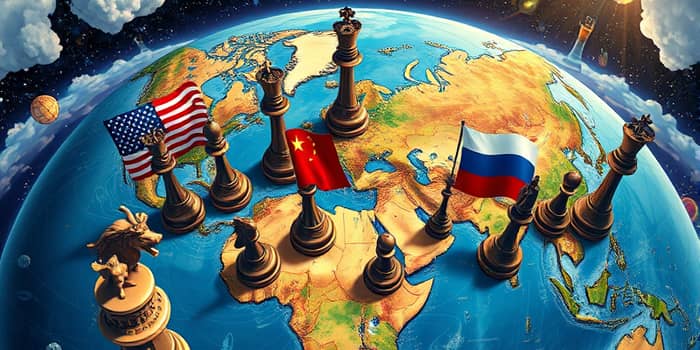
In 2025, the global landscape resembles a high-stakes chessboard where superpowers maneuver for advantage. For investors, understanding each move can unlock powerful opportunities and mitigate risks.
The year 2025 marks a period of intensified strategic competition among the United States, China, and Russia. National security concerns now often outweigh traditional economic efficiency, reshaping trade policies, alliances, and investment flows.
America First nationalism under the new US administration has led to a recalibration of trade agreements, withdrawal from multilateral institutions, and the deployment of tariffs as strategic tools. In response, China has doubled down on its own economic stimulus, accelerated its military presence in the South China Sea, and deepened its pursuit of critical minerals to secure supply chains.
Meanwhile, Russia’s conflict in Ukraine continues to disrupt European energy security, driving up inflation and compelling nations to seek alternative suppliers. The Israel-Hamas crisis further complicates Middle East dynamics, affecting global food and energy markets.
Each actor on this geopolitical chessboard employs unique strategies:
Beyond these, Asia-Pacific tensions over Taiwan and the Korean Peninsula remain flashpoints. Fractured trading blocs emphasize bilateral deals, as many nations lose faith in broad multilateralism.
These geopolitical maneuvers create a cascade of economic consequences:
Inflation has been stoked by renewed tariffs on imported goods, while consumer prices remain elevated despite central bank efforts. Policy interest rates hover above pre-pandemic lows, tightening financial conditions globally.
In the energy sector, the Russia-Ukraine crisis has accelerated decarbonization initiatives. The US Inflation Reduction Act has spurred massive investment in renewables, yet fossil fuel–dependent nations resist, creating further geopolitical friction.
Trade finance is digitizing rapidly as businesses pursue friendshoring for critical minerals and regional manufacturing hubs in Southeast Asia and Africa to reduce reliance on China. Meanwhile, digital assets gain traction in trade settlements under US encouragement.
In technology, the intensifying US-China “Cold War” has fractured supply chains for semiconductors and artificial intelligence hardware, fueling regional rivalries in power generation, labor markets, and capital expenditure.
Defense budgets are surging worldwide, reflecting heightened fears of conflict escalation. Countries are prioritizing military modernization, cybersecurity, and intelligence capabilities.
In this unpredictable environment, investors must adopt adaptive, scenario-based approaches to protect capital and capture growth:
By combining defense-oriented assets with forward-looking innovation plays, investors can build portfolios that thrive amid fragmentation.
Effective navigation of geopolitical risks demands sophisticated analytical frameworks and real-time intelligence:
Geopolitical risk dashboards synthesize data on top threats—conflicts, sanctions, tariff announcements—and quantify their potential market impacts. Monthly geostrategic updates from specialized research teams offer scenario planning for possible US-China escalations.
Firms reexamine their supply chains with advanced mapping tools, identifying chokepoints in semiconductor production and critical mineral sourcing. Corporate leaders are embedding geopolitical stress tests into capital expenditure decisions and establishing crisis-response cells to react swiftly to emerging developments.
As the world’s leading powers continue their complex chess match, the most successful investors will be those who anticipate moves, adapt swiftly, and balance defense with opportunity. By staying informed, diversifying thoughtfully, and leveraging thematic growth areas, one can transform geopolitical risk into a source of competitive advantage.
The chessboard of 2025 will remain dynamic and contested, but with disciplined strategy and robust risk management, investors can navigate toward victory—and long-term growth.
References