Search
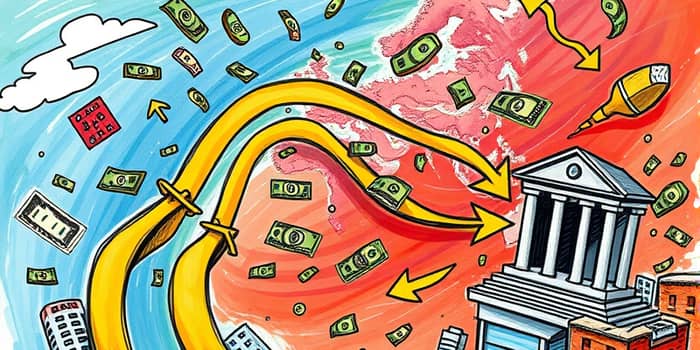
In an interconnected world, the ebb and flow of money shapes economies, markets, and personal opportunities. As the tide of global funding recedes in some regions and swells in others, businesses and investors face a landscape marked by both challenge and promise.
Understanding these shifts is critical for anyone seeking to protect assets, seize opportunities, and navigate uncertainty with confidence.
Global liquidity is the measure of funding available across borders, driven by central bank actions, government spending, and market sentiment. After a massive surge in liquidity during 2020/21 tied to pandemic stimulus, central banks are now unwinding support.
By mid-2025, many economies show signs of tightening financial conditions, but the impact varies widely by region and asset type. Recognizing this uneven terrain can empower investors and policymakers to craft resilient strategies.
Policy shifts among major central banks have created a patchwork of conditions across the globe. While some regions tighten, others maintain or increase accommodation.
Multiple forces converge to shape today’s uneven liquidity landscape. By understanding each driver, market participants can anticipate turning points and adapt thoughtfully.
Concrete numbers highlight the depth of current trends and aid in benchmarking future developments.
These figures illustrate a market still digesting prior waves of stimulus, while confronting fresh rate pressures and refinancing peaks.
The divergence in policy and market dynamics creates distinct pockets of ease and strain.
In advanced economies, central banks grapple with inflation and debt sustainability. In contrast, China and select emerging markets lean into easing to rejuvenate growth, even as currency outflows challenge stability.
Asset classes diverge too: money market funds and ultra-short instruments attract flows with their positive real yields and flexibility, while high-yield credits and commercial real estate face a looming debt refinancing wall through 2028.
Financial intermediaries adapt, using ETFs and alternative funding channels to manage risk, yet less-liquid segments remain susceptible to sudden shifts in sentiment.
In this complex environment, clarity and discipline can transform uncertainty into opportunity. Key recommendations include:
By defining clear risk parameters and maintaining cash reserves, investors can position themselves to act decisively when windows of opportunity emerge.
Despite cautious guidance, several risks may reshape markets near term:
If Quantitative Tightening continues while the Treasury General Account balances rebuild rapidly, a liquidity crunch could arrive as soon as September 2025. Such a squeeze might trigger greater market stress and force central banks to recalibrate prematurely.
A sudden shock—be it from a geopolitical flashpoint, a debt event, or fresh inflationary pressure—could expose vulnerabilities in sectors stretched by leverage. Under such conditions, financial stability may come under strain, demanding nimble responses from policymakers and investors alike.
Conversely, should growth slow sharply, central banks might pivot to easing earlier than expected, unleashing a second wave of liquidity relief and prompting fresh asset rallies. This “double-hump” cycle, with tightening followed by renewed stimulus, underscores the need for flexible strategies that adapt as conditions evolve.
Ultimately, the uneven tightening of global liquidity presents both risks and opportunities. By grounding decisions in data, focusing on resilience, and seizing tactical openings, individuals and institutions can navigate this dynamic landscape with confidence and purpose.
References